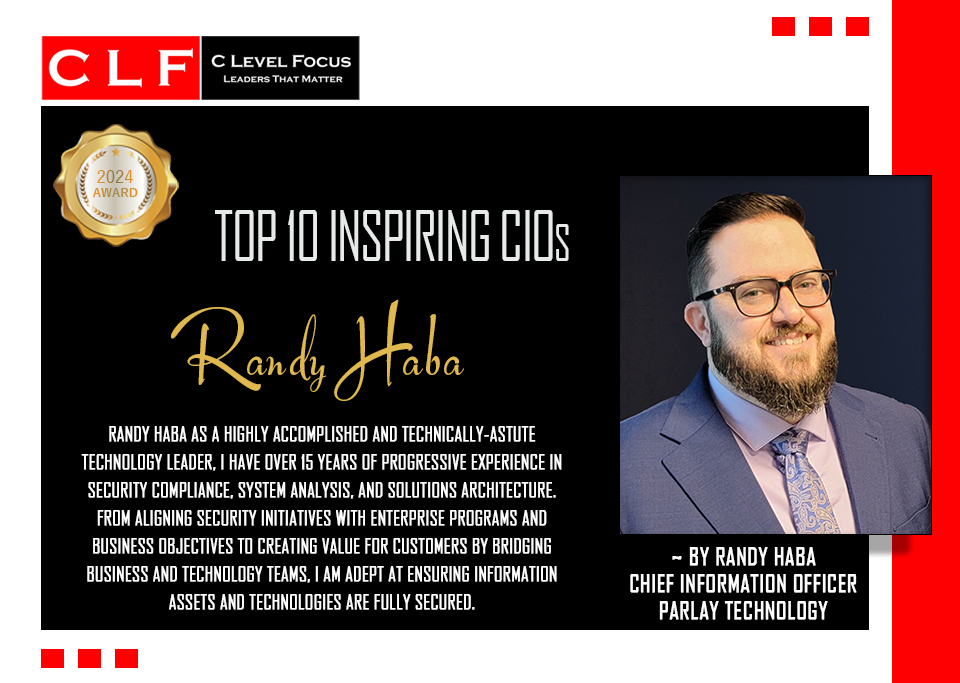
Striving seamlessly to integrate technology with the unique business needs of its partners, Parlay Technology’s approach involves thoroughly understanding its core challenges. With Randy Haba as its CIO, Parlay Technology can develop thoughtful and impactful technology solutions that support its growth and success.
Randy, who grew up in Texas, attributes his character development to his upbringing on a 300-acre ranch where he raised cattle and helped his father with typical ranch chores. Their early mornings, starting at 4 am, taught him a strong work ethic and the fulfillment that comes from completing tasks. At 11, his mother recognized his knack for technology and bought him his first computer, which he eagerly disassembled. This ignited his enduring interest in how technology can improve lives and optimize business processes. He began his professional journey at Perot Systems and Dell Services, where he assisted hospitals in adopting medical records software. About 12 years ago, he shifted from the corporate world to concentrate on helping small and midsized businesses effectively leverage technology to achieve their goals.
Randy is a passionate board gamer who realized around five years ago that there is a broader selection of board games than you typically find in big box stores. To succeed, many games demand strategic thinking, rapid decision-making, and even negotiation. Playing these games continually sharpens his critical thinking skills and improves social interactions. This experience also aids his professional development, as he frequently needs to make swift decisions with little information, which can significantly impact his organization's success.
According to Randy, the ability to be nimble was the single most significant change for him as a leader. Creating a team or plan that could shift quickly was incredibly challenging. When selecting a technology suitable for 100 individuals, securing a contract necessitates doubling or tripling the workforce to satisfy the demand. It’s truly an exciting time; being agile and able to adapt to the quick pace of change was the most significant hurdle and required the most change for himself and his team.
In light of each organization's distinct traits and responses, Randy highlights the significance of developing a strategic vision and says there is no one-size-fits-all model for planning. He has explored various goal and objective modeling frameworks and chooses one that aligns with the organization. If a framework is already in place, he adapts and integrates technology at all levels of the business, recognizing the potential for improvements in efficiency and scalability, especially with the rise of AI. Prioritizing technology that resonates with the organization and its employees is critical for successful implementation, just as user adoption is critical for resource efficiency.
For Randy, the principle is "people first." Randy exemplifies a servant leadership style grounded in trust. He prioritizes being available for his team, setting aside time to check in on their well-being and support their success. He values each individual's needs, including their family, and strives to create a healthy work-life balance. Randy believes that trust is crucial for effective teamwork, allowing him to avoid micromanaging and empower his team members to fulfill their responsibilities. His approach fosters a positive environment where his team can thrive at work and in their personal lives.He emphasizes that with trust in your intentions, individuals will be willing to support your proposals. Gaining employee buy-in is essential for adoption, and it applies to everyone in the organization, from executives to custodians.
As a highly accomplished and technically-astute technology leader, I have over 15 years of progressive experience in security compliance, system analysis, and solutions architecture. From aligning security initiatives with enterprise programs and business objectives to creating value for customers by bridging business and technology teams, I am adept at ensuring information assets and technologies are fully secured.
Since technology can impact various business areas, it's critical to unite the relevant personnel in the decision-making and planning to achieve the best outcomes. Besides, he adds that 'Trust' is the foundation of collaboration, and your willingness to collaborate decreases if you lack it. To establish trust, it is crucial to begin with a clear understanding of the purpose, garner support from others, and collaboratively move forward.
In addition to those in technology positions, Randy underscores the significance of interacting with colleagues at all levels of an organization. He adopts a business-first mindset, recognizing that tech-focused individuals may not align with the organization's goals. He engages with people from different industries to understand their challenges, market dynamics, and internal issues. Transitioning from a technical background to prioritizing business needs has been challenging but essential. This allows him to remain flexible and incorporate diverse ideas from other sectors, even if they aren't technology-related.
Randy, a CIO and consultant, believes that traditional practices often need more attention toalign technical goals and products with business needs. He emphasizes the importance of understanding the "why" before recommending technology or business pursuits. He believes that determining the necessary product or process to achieve desired outcomes is challenging without identifying the specific requirements. To effectively determine the required product or process to achieve desired outcomes, his approach addresses this issue by ensuring that decisions are based on the company's needs.
Randy also observes that security issues in the tech industry are becoming more prominent, impacting corporations and individuals. He cites three major incidents in which significant carriers or data brokers exposed millions of people's personal information. He emphasizes the importance of understanding these breaches' consequences forthe company's and individuals' future security. The vast amounts of personal data shared on social media increase everyone's susceptibility to manipulation. If a malicious actor takes the time to understand their target, they can enhance the effectiveness of their attacks. People often prioritize safety and security only after issues arise, as the automotive industry illustrates.
The initial gasoline-powered vehicle was created in 1893, and Volvo introduced seat belts in 1889. Still, it wasn't until 1959 that regulations required seat belts in all cars to reduce fatalities from accidents. As technology advances quickly, safety measures and associated risks constantly change, leading to concerns about achieving a proper balance in risk management, claims Randy. Human behavior frequently serves as the most vulnerable aspect of security breaches. If people are oblivious to their contribution to these risks, the likelihood of incidents will continue until a significant shift occurs.
Posted in CLF | Top 10 Inspiring CIOs of 2024, Randy Haba, Chief Information Officer of Parlay Technology Profile