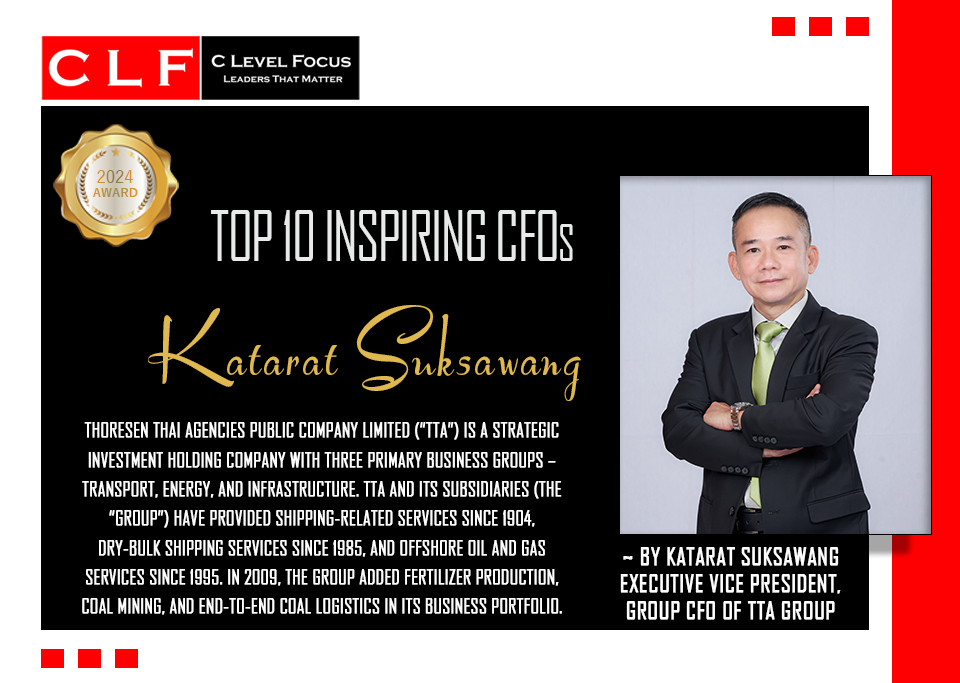
Katarat Suksawang, in his role as the valued Executive Vice President and Group CFO of TTA Group, leads a visionary investment conglomerate committed to intelligent and sustainable expansion. With a diverse range of business ventures encompassing shipping, offshore services, agrochemicals, food and beverage, and more, their steadfast mission is to nurture and enhance existing enterprises while actively seeking out futuristic prospects. Through a relentless pursuit of cutting-edge technologies and groundbreaking business frameworks, they strive to remain a vanguard in their industry, continuously sharpening their competitive advantage.
Their investment strategy is forward-thinking, and Katarat believes that a company's vision should be in line with global trends that impact their business, such as technological advancements, changing demographics, environmental concerns, and social movements that will impact the future. They recognize the growing importance of sustainability and have joined the Thailand Business Council for Sustainable Development (TBCSD) to promote environmental awareness and invest in water resource management, solar energy, biomass, and electric vehicles. They are also involved in businesses related to artificial intelligence, blockchain, and digital assets. Additionally, they invest in startup companies that have the potential for rapid growth and scalability, particularly those with a unique value proposition. Their goal is to support startups that follow a traditional S-curve growth trajectory after finding success in the market.
The company’s strategies and success can be attributed to Katarat's leadership approach, which is founded upon the principles of mentoring, delegation, and empowerment. He defines delegation and empowerment as giving others jobs and responsibilities while still taking responsibility for the results. As a successful leader, he lets his team explore and find answers with support and resources.He discovered that his team is more dedicated and accountable. With more professional experience, he mentors his team, inspiring and empowering them to take responsibility for their learning and growth rather than providing them with direct answers. He also helps his staff set achievable goals for each job task and gives constructive, precise input on his team's strengths and weaknesses. Adding to it, he also aligns goals with the organization's mission and vision to set and integrate them across all levels. In order to disseminate organizational objectives to individuals, he advises fostering and communicating teamwork and establishing key performance indicators (KPIs) at each target level to monitor performance and development.
Katarat believes that a team environment allows for diverse perspectives to be brought to problem solving, making everyone's contributions more valued. When all team members are encouraged to give feedback without hierarchy, people are more open about their ideas. In his view, good teamwork improves group outcomes and organizational effectiveness. Working as a team on a project leads to a sense of accomplishment that goes beyond individual achievements. The company prioritizes team-building activities to improve employee engagement and retention, believing that strong teamwork is built through communication, collaboration, trust, and a positive work environment.
In further elaboration on his work ethic, Katarat states: “It is important for us to find happiness in our work, as it takes up a significant portion of our daily lives. As the quote suggests, the best job may not always be the one we love, as opportunities to do what we truly love are limited. Therefore, it is essential to approach our work with mindfulness, dedication, and the intention to give our best effort. By doing so, we can make time fly by and experience joy and excitement in our work. It is his conviction that positivism fosters advancement as opposed to impeding it.
Next are the competitors, and in the realm of competition, Katarat believes that one must navigate with diligence and finesse. Staying updated on plans requires setting clear goals and measuring performance, following the SMART principle. Based on his experience, he explains that competitive analysis can help identify strengths and weaknesses, such as in the dry bulk shipping business, where OPEX costs are a key success driver which TTA has significantly managed 16 % lower from the industry. To manage and maintain low OPEX costs, two major tactical strategies were developed, including maintain in-house crew management and continue promoting sustainable cost leadership culture as well as related activity program . The company also established relationships with key merchant marine academies to sponsor and educate industry knowledge in order to be the most attractive seafarers working place for high-quality new graduated marine student and then we build cost efficiency culture from the scratch.
To sum up, the company is investing in environmentally friendly projects that align with global trends and contribute to society. They have started investing in businesses that promote the reduction of global warming and the conservation of fossil fuels, such as water resource management, solar cell production, electric vehicles, and biomass. These investments align with customer demand for more environmentally conscious products.
Posted in CLF | Top 10 Inspiring CFOs of 2024, Katarat Suksawang, Executive Vice President, Group CFO of TTA group Profile