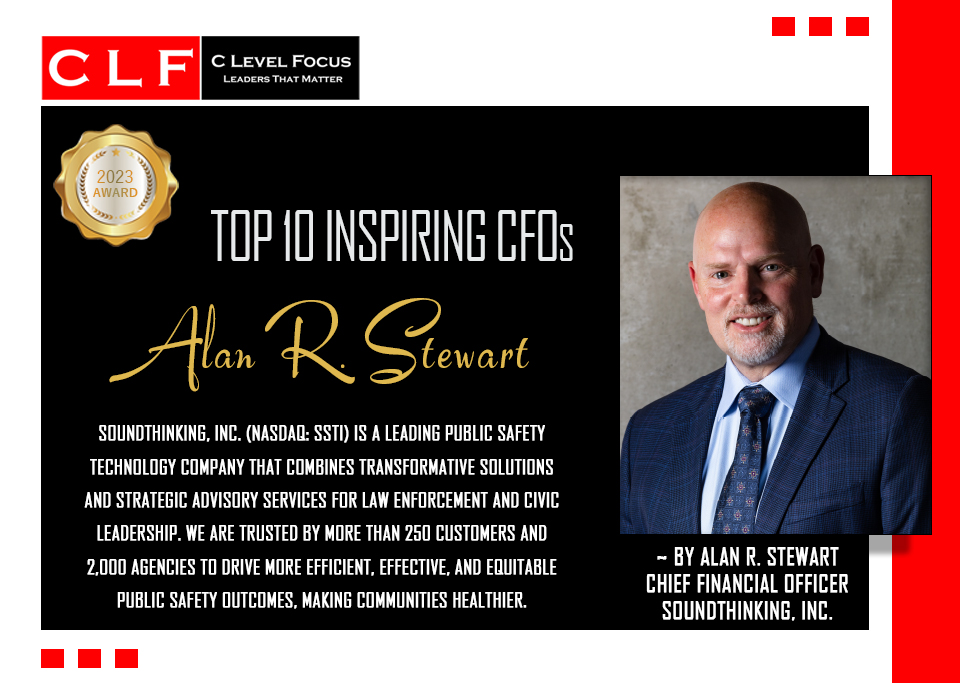
SoundThinking, Inc. (Nasdaq: SSTI) is a leading public safety technology company that combines transformative solutions and strategic advisory services for law enforcement and civic leadership. With Alan R. Stewart, CFO, the company was founded as a mission-based organization focused on improving community safety and attracted those who came from public service or wished to join the cause.
The CEO was an old friend and an incredibly successful entrepreneur of Alan's, and he had known him for nearly 25 years as a Harvard Business School sectionmate. He asked Alan to help take the company public. Despite knowing little about the organization, Alan thought the chance would be difficult and exciting. Six years later, Alan is still at the company, which he loves. They've done amazing things, raising revenue by over 500% since going public.
Alan believes that “Effective leadership is more about team building, working with others, and training than individual accomplishment.” Finding the right team members is difficult but worth the effort. Effective leaders focus on teamwork, cross-training, character, and integrity. In his view, micromanagement rarely works well, so leaders should distribute tasks, solicit updates, and only get personally involved to solve problems or train their staff. With this in mind, communicating with the company should be done on a regular enough basis to guarantee that employees feel important and that corporate leadership believes it is appropriate to keep them updated on progress, positive activities, and issues that the company is facing.
Alan adds that weekly staff meetings allow smaller teams to discuss significant topics and updates. All-hands meetings for the entire company can be done less frequently, perhaps monthly, but they should contain similar information and possibly additional information on recent goals and successes, especially if the executive team can highlight who contributed to the positive results.
In regard to decision-making, Alan suggests that since it includes numerous key factors, the corporate executive team and appropriate staff should understand and explain the ultimate goals and results. Once the desired results are set, strategies to achieve them require understanding the current initiatives that are working well and helping to achieve the goals, as well as those that are not working as well or may even be harmful. Leaders should listen to participants to make good decisions. This demands open communication and a willingness to hear and understand input that may challenge current actions or change eventual aims. The company's leadership is ultimately accountable for the success or failure of any strategy endeavor; however, being willing to take employee feedback on goals may be vital before making or retaining current strategies.
Alan says their staff ARE their greatest asset. Most are strongly motivated to help the organization succeed and recognize its goals and strategic objectives. Their employees find their purpose intriguing, unusual, and desired because many of their software solutions focus on public safety, especially for marginalized populations. The company has developed tremendously since going public five years ago. Their software products now help the company grow from one and as they grow, they hire great people who want to help the firm succeed.
Further, Alan describes their huge market. They prioritize gun-violence-plagued cities. Over the past few years, they have added US states, federal agencies, and overseas customers and programs in South Africa, the Bahamas, and Southeast Asia. Their market is over $2.5 billion. Over 250 customers and 2,000 agencies trust them to improve public safety and community health.
In terms of strategy, the company has several primary goals. The first one is to create satisfied customers that stay with the company for many years, and they have achieved that goal.
In fact, the company has consistently achieved a NPS (Net Promoter Score) score of over 55 for several years, putting them in a distinguished small group of companies nationally that are recognized for customer loyalty and satisfaction. Related to keeping customers with them for many years, their customer retention for SoundThinking consistently exceeds 99%, and has done so for the last three years. Their second goal is to obtain and retain excellent employees. They achieved these aims by keeping staff informed and active in all corporate activities, including strategic initiatives, product development, and customer satisfaction. SoundThinking has been a Great Place to Work® company for four years, according to their input.
In recent years, the business has bought and developed several other gunshot detection products. SoundThinking rebranded and introduced the SafetySmart Platform to help law enforcement and civic leaders improve public safety. Their SafetySmart™ Platform includes ShotSpotter®, the leading acoustic gunshot detection system; CrimeTracer™, the leading law enforcement search engine; CaseBuilder™, a one-stop investigation management system; and ResourceRouter™, software that optimizes patrol and community anti-violence resources. These intriguing projects encourage their workforce. ShotSpotter gunshot detection, their core software product, grows each year, but their three additional software products, purchased and created in the last two years, are even more interesting. These products grow and profit the company and expand their SafetySmart platform of software solutions.
Their success depends on understanding consumer and community needs. They can create and provide better software solutions if they know what they want. As they do that, their company expands and needs more employees, and the positive activities should boost shareholder value.
Posted in CLF | Top 10 Inspiring CFOs of 2023, Alan R. Stewart, Chief Financial Officer of SoundThinking, Inc. Profile